
Toronto's family rental market looks different from the condo and apartment market. Bedroom count still matters, but it is not enough. A three-bedroom detached rental, a semi-detached home, an attached townhouse-style rental, and a portion of a larger single-family property can all appear in the same bedroom category while serving very different renters.
For this August 2026 report, Casakibo reviewed active Toronto residential lease listings and grouped house-oriented rentals separately from apartments. Rare multi-unit formats were excluded from this article because those categories are uncommon in the active listing sample and can produce unreliable segment medians.
The resulting Toronto house and family rental sample includes 2,350 active listings. The median asking rent is $2,445 per month, while the average asking rent is $2,963. The middle half of the market sits between $1,800 and $3,400 per month, which shows how wide the family-rental range is in Toronto.
Active Toronto house and family rental listings by home segment, August 2, 2026:
| Home Segment | Active Listings | Median Rent | Average Rent |
|---|---|---|---|
| Detached | 1,639 | $2,300 | $3,012 |
| Attached / townhouse-style | 418 | $3,100 | $3,256 |
| Single-family labelled, type not specified | 293 | $2,150 | $2,271 |
Detached rentals are the largest part of this sample, with 1,639 active listings and a $2,300 median. That number can look lower than expected because detached rental listings often include basement apartments, upper-level rentals, partial-home rentals, and other non-whole-house arrangements. The average detached rent is $3,012, which shows how much variation exists inside the detached category.
Attached and townhouse-style rentals show a higher median at $3,100 across 418 active listings. These listings often compete with larger condo units, but they can offer features renters may not get in a tower, such as private entrances, more storage, parking, or outdoor space.
Bedroom count gives another useful view. In the active Toronto house and family rental sample on August 2, 2026, one-bedroom listings had a $1,675 median, two-bedroom listings had a $2,200 median, three-bedroom listings had a $3,000 median, and four-bedroom-plus listings had a $4,250 median.
Active Toronto house and family rental listings by bedroom count, August 2, 2026:
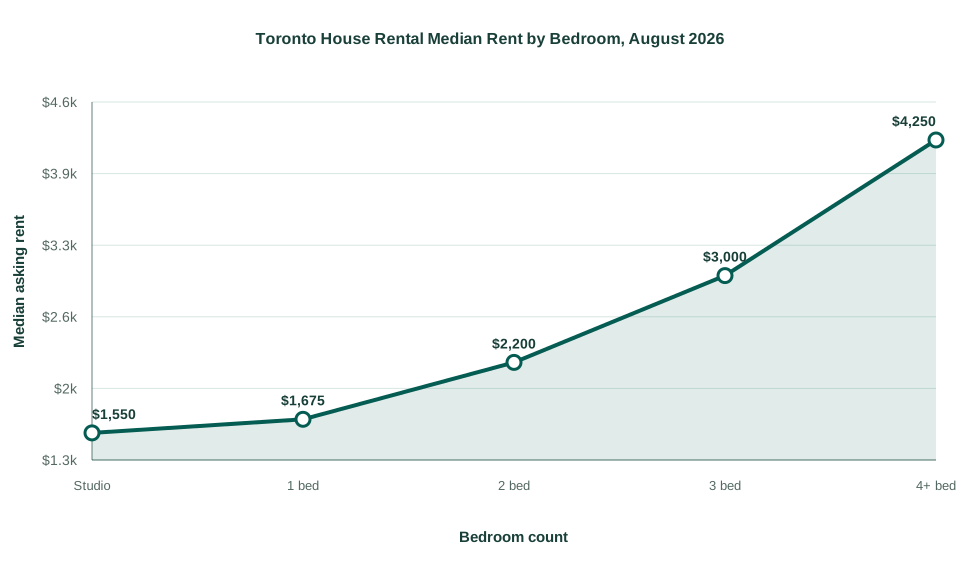
For families, the sharpest jump appears when moving from two bedrooms to three or more bedrooms. The median rises from $2,200 for two-bedroom house-oriented rentals to $3,000 for three-bedroom rentals. The four-bedroom-plus segment is much more expensive, with a $4,250 median and a $5,302 average, reflecting larger full-home listings and premium neighbourhoods.
For renters, the practical lesson is to read the listing details closely. "House for rent in Toronto" can mean a full detached property, a townhouse-style rental, an upper-level unit, or a basement suite. The rent can change dramatically depending on privacy, number of entrances, parking, outdoor space, laundry, utilities, and whether the rental is a full home or part of a home.
For landlords and realtors, the same caution applies when pricing a family rental. The best comparable listings should match home type, neighbourhood, living area, parking, outdoor space, bedroom count, and whether the rental is a whole-home or partial-home offering. A broad Toronto median is useful for orientation, but it is too general for final pricing.
Browse current Toronto rentals on Casakibo's Toronto rental hub: Toronto rentals on Casakibo
Compare live Toronto and GTA rentals from the Casakibo homepage: the Casakibo homepage
For sellers and landlords researching pricing context, visit Casakibo Home Worth: Casakibo Home Worth
The Casakibo Data Labs prepare rental-market research using structured listing data, property-type segmentation, and local market checks. This report was prepared by the Casakibo Data Labs using thousands of active residential lease listings from participating Canadian real estate boards and CREA member feeds. For data questions, market research, or partnership inquiries, contact Casakibo here: contact Casakibo